

When you’re starting out, the ultimate goal for any musician is to sign a major label record deal. It symbolizes that you’ve made it.
When I studied production, the apex of success was working with signed artists. Working with Grammy-winning artists was even better. Just stating that you were collaborating with someone who had a record deal meant you were successful.
Fast-forward to today’s industry, and I doubt many people know or care about the record labels backing their favorite artists. Even the young people I meet at conferences rarely ask how to get signed or meet an A&R person.
It seems like that aspect has been forgotten.
This is the impact of streaming on the industry. If anyone can sign up with DistroKid or TuneCore, release their own material, and become their own record label, then what’s the point, right?
There are major advantages and disadvantages to having a record label.
Another issue is that major label contracts have earned a bad reputation for exploiting artists. But is that really true?
Let’s explore some of the pros and cons.
Table of Contents
3 Reasons You Might Still Want A Record Deal
Advances
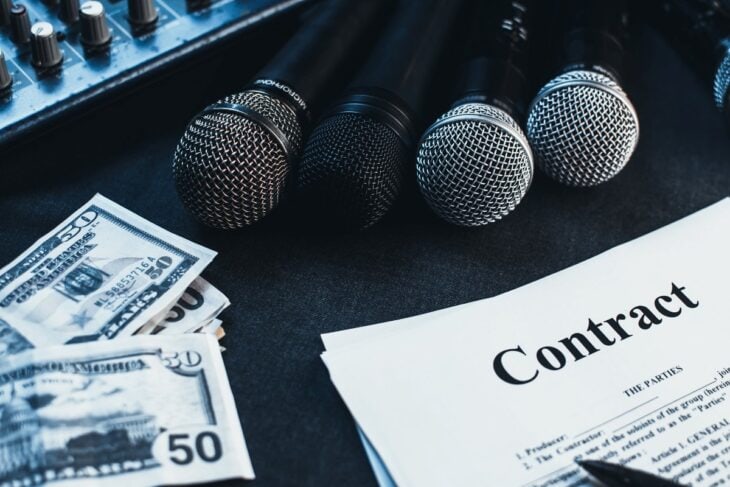
If you’ve ever watched a hip-hop video, there’s a good chance you’ve seen this scene: an artist walks into a record label, struts out with a massive check, and heads straight to the dealership to buy a shiny new Mercedes G-Wagon. It’s a fun image, but it’s not exactly the whole story.
Record labels actually do a lot more than just hand over a check. They’re like the financial backbone for artists, covering the heavy costs of high-quality music production.
That means they’re the ones hiring top-notch producers and mixers, and connecting artists with hit songwriters. All of this is possible thanks to the record label’s deep pockets and industry connections.
A record deal can also provide artists with the freedom to focus completely on their music, as the advance often covers living expenses. This is a big deal, especially for artists who aren’t rolling in dough.
Having the chance to quit their regular jobs and throw themselves into their music can be a game changer.
So, are record deals the only way? Not necessarily. There are other ways to fund your career, like running a GoFundMe campaign or inking a production deal with a producer who agrees to work on your album for free in return for a cut of future sales.
However, these options may not be as life-changing, and it’s not clear who’s going to foot the bill for your living expenses while you’re making the record. That’s why the idea of a big check from a record label can still be pretty appealing.
Artist Development
The A&R executive, short for Artists and Repertoire, acts as your personal mentor and protector in the maze of the music industry. He’s the record label version of Yoda.
Ideally, if you’re considering signing with a label, it’s because you trust their expertise to make wise decisions. This is a challenging task, given that the music business has a rocky path with about a 90% failure rate.
Most of the time, record releases don’t recoup their investment, making it somewhat of a gamble for labels to sign new talent.
With this in mind, label executives strive to pair you with the most exceptional songs and production to maximize your chance at stardom. To hit this target, they often have to reject many options.
Their goal? To give a resounding yes only to the absolute best – the most engaging track, the catchiest song with a hook that won’t quit, and the most compelling lyrics that reflect your artistic vision.
Producers also play a vital role in artist development. Sure, you could bypass label executives and let your producer guide you, but this path can be complicated. The main hitch arises when you release your record on platforms like Spotify.
Unless they’re successful enough to own their own label, most producers may not possess the skills to effectively market an artist. You could create a sonic masterpiece, but if you’re trying to promote your work on social media and relying on free resources,
it generally doesn’t generate the same buzz as being signed to a record deal.
Tour Support

Remember when record labels were all about selling music and getting as many streams as possible? Well, they soon realized that it’s pretty tough to sell tunes from artists no one’s ever heard of.
So, they decided to put some money behind promotional tours.
For those up-and-coming artists, they’d plan out a special tour to help them get their names out there. This often meant rocking out on big stages like the Today Show in good old New York and putting on showcases in major cities like Los Angeles, Miami, London, and Vancouver.
All this was to create a buzz around that shiny new album.
The band Pomplamoose spilled the beans on Medium.com about how they ended up in the red after trying to manage their own 28-day tour, crossing their fingers they’d sell enough tickets and music to make a profit. But here’s the thing: selling out major venues when you’re not well-known is no walk in the park.
In fact, those venues won’t even look your way unless you’ve got a bit of success under your belt. It’s the ultimate catch-22: how do you get fans if you need fans to get fans?
This just goes to show another reason why having the backing of a record label can be a total game-changer.
3 Reasons Not To Get A Record Deal

Recoupment
You know that dream of striding into a record company and walking out with a fat check to buy a sports car? Well, those hip-hop videos didn’t clue you in on the fact that this money isn’t a free ride – it’s got to be paid back.
That’s right, it’s an advanced loan, not a gift. So, if you splurge it all and your record doesn’t hit the mark, you’re in the red with the label.
Their standard way of getting their money back is to trim your earnings for your next record, or give you a smaller advance the next time around. So, you’re starting your second record already owing money from your first one.
This is the reason many artists air their grievances publicly about record labels, painting them as modern-day slave drivers. Artists claim that labels make them toil away without giving them another dime.
However, the reality is that these artists perhaps didn’t manage their initial funds well due to not fully grasping their deal.
Now, when it comes to discussing advances, things get tricky. Even when managers and lawyers break down what an advance involves, the large numbers can make artists’ heads spin and they might agree to the deal without completely understanding it.
And here’s the kicker – not only does the advance have to be paid back, but it also comes with a hefty interest rate, way worse than any bank. Let’s say a label hands you $100,000 to make your record and you earn the standard artist royalty of 14% or 15%.
You’re essentially paying back your advance at a whopping 85% interest rate. To pay back $100k you need to make $600k, yikes.
Now, you might be thinking this should be against the law. The good news is, things have changed a bit for independent labels, who generally don’t go for these types of deals anymore.
They usually prefer to split the revenue, often 50-50 or 70-30, depending on the situation. But the reason for the sky-high interest rate is that the label is taking a big gamble by giving you $100,000 upfront without any surefire promise of getting it back.
Master Ownership

Remember when Taylor Swift, her former manager Scooter Braun, and her old label, Big Machine, were all at odds? Taylor let her fans, the Swifties, know that she didn’t own her own music.
A bit of a commotion ensued because this statement was slightly confusing. Fans began to steer clear of the label and even started protests.
This led to Taylor uncovering a clever workaround in master ownership, which resulted in her creating her own versions of her songs – a move that definitely stirred the pot!
You see, the advance you get when you sign a record deal isn’t just a straightforward payment. It’s more like a loan, and to get it, you have to agree that the label owns whatever they paid for.
They don’t own the songwriting per se, but the actual music recording, or what’s referred to as a “master recording.”
Taylor cleverly navigated her situation by recreating her album from scratch, thereby creating a new master recording. It’s as if she covered her old music, meaning that the fresh master titled “Taylor’s Version” wasn’t under the ownership of the record label.
This was truly groundbreaking and sparked quite a stir, as she paved the way for other artists to follow suit. Naturally, not all artists are blessed with Taylor’s dedicated army of Swifties, ready to purchase a million albums just to stand up to the label.
This was interesting because for once, the public got a view of how labels structure deals, and it was quite shocking to fans.
Stay tuned for my next article, where I’ll delve into the world of publishing and songwriting, to give you a fuller picture of this situation.
Conflicting Vision
For artists, one of the biggest considerations, aside from the intricacies of legal contracts, is finding a label whose A&R aligns with their creative spirit.
Imagine spending years honing your craft, perfecting your image, and building your personal brand, only to find that the label wants to alter things – perhaps your lyrics, your look, your style, or even your name. It’s easy to see how this could cause friction.
Unfortunately, some artists don’t anticipate these changes until they’re deeply involved in their first or second record deal. This can lead to larger issues, like trying to negotiate their way out of contracts.
Consider the legal dispute between Kesha and Dr. Luke. Kesha alleged sexual harassment, seeking to sever her contract. While we’re still waiting for the final verdict from the courts, one thing is certain: contracts are like super glue, and trying to break free from them can get extremely complicated.
Final Thoughts
So, here’s the deal: whether a record deal is beneficial for an artist really boils down to your personal network.
If you’re someone who’s been rubbing elbows with producers and marketing folks, and you have a supportive manager, plus you’re making enough to pay the bills while creating your masterpiece, then you probably don’t need a record deal these days.
But let’s be real, assembling your own team can be really tough, especially if you’re not in a major music city. If you’re just a dreamer with a guitar in a small town, it could be difficult to even afford rent in a big city to pursue your music without the financial backing of a record label.
Of course, there’s always the DIY route – producing your own music, managing your own career. Some folks are doing it, but the big question is: can they sustain it? Are they making enough to do music full-time? Well, that’s up for debate.
