
Have you ever written a song that you’re proud of, but don’t know how to make it sound good on a piano? Or perhaps a bandmate gave you a lead sheet, with nothing but a single melody and chord symbols, and you want to make up a full piano accompaniment.
In both situations, a solid left-hand accompaniment can make all the difference. Most folks know how to peck out a melody and can play basic chords. But not many – pianists included! – know how to accompany that knowledge with a rich-sounding left hand.
Fortunately, the left hand doesn’t have to do anything technical to sound effective. Below, I’ll take a look at several left-hand patterns you can use to elevate the sound of your playing.
Table of Contents
Things to Consider When Playing Left-handed
Before diving into our left-hand patterns, it’s helpful to know how the left hand is used.
It goes without saying that the piano is one of the most versatile instruments out there, and is used in almost every music genre; however, in every case, its function can be boiled down to three things: melody, bass, and harmony.
When the piano is played solo, it’s doing all three things at the same time. It also has to be on beat, rolling along with the rhythms and heartbeat of the music. As I like to say, rhythms and beats are the “glue” that hold everything else together.
So … what does this all have to do with the left hand? As it turns out, quite a bit!
Obviously, your right hand is also playing. 99% of the time, it’s covering the melody. Most of the time it’s also playing chords (or at least a few notes at a time).
This leaves a few options for the left hand. Playing bass is the most apparent, but it can also flesh out harmony and rhythmically propel the song forwards.
To use your left hand effectively, you should know what your right hand is accomplishing and the “nature” of your song. If your song is a jazz ballad, you might want to emphasize rich harmonies. If it’s a funk tune, then your left hand will be a drum kit!
With that in mind, we’ll start with the easiest pattern.
Pattern 1: Pop Chords
This pattern is so simple, it might be overkill to call it a “pattern” at all. Nevertheless, in the right context, it can work quite effectively!
“Pop chords” are simply triads played on every beat, or every eighth note. When played staccato or drily, they make a song uplifting and catchy. When played legato and slurred, they can sound calming.
With this humble pattern, you cover harmony. You can accent different beats, creating on-beat or syncopated rhythms. Even better, it sounds great solo or with a band!
Here’s some advice to consider though: pop chords can be played with both hands, and should be played in the mid-range of the piano.
This simple pattern is found all over the place; the Beatles used it often, on tunes like “With a Little Help from My Friends” and their outro in “Hey Jude.”

Pattern 2: Bass
If you don’t know where to start with your left hand, best practice is to simply play the root of each chord (or the bassline, if it’s written out). This forces you to learn the harmony and form of the song.
Often, bass notes are all you need (just like “love,” right J. Lennon?!) Because bass is so important to a song, simply outlining a song’s chord progression is enough to support everything.
You have many options. At its most basic, you can just play each root once, for every chord change. This is actually very common – piano legend Billy Joel does this himself on his hits “Piano Man.” You can’t get more bona-fide than that!
Go up a level, and you can repeat the bass on every beat or eighth note to create rhythmic propulsion. You can also play your own basslines with passing tones, like “Anthony’s Song” (also Billy Joel), or do everything on a syncopated beat.
It can be as basic or complex – as long as it’s effective.
However, a few things should be taken into consideration; first, your right hand should play chords to fill out the sound. Second, if you’re in a band, your bassist will already be covering bass (which lets you explore other ideas – yaay!)
Pattern 3: Arpeggios
Now we come to the most pianistic pattern of all: the kaleidoscopic arpeggio! Any instrument can play arpeggios, but few use them as effectively as piano.
An arpeggio is just notes from a specified chord, played one at a time. Most often, they are the root, third, and fifth. They’re usually subdivided into neat eighth notes, and use every chord quality, so they effectively conjure up a full sound.
Here’s the most basic arpeggio: root, fifth, root-up-an-octave, fifth. It’s often played in quarter notes or barred eighths.

Go up a level, and you can include the third.

Shuffle it up a bit, and you can play the notes in different orders and patterns! You can even include the second and sixth, and create miniature melodies. Aaah, the possibilities!

Given their mutability, you could write a whole book on arpeggios. Rather than bore you, I’ll give two comments: first, even the most basic arpeggio can sound beautiful – here is an example from Joni Mitchell’s classic tune “Blue.”
Second, if you are looking for new arpeggio patterns, check out classical composer Chopin – especially his nocturnes. He is the master of arpeggios, and his patterns can be used in many contexts.
Pattern 4: Blues Shuffle
This pattern is used with the classic 12-bar blues progression (duh!), but it can be used in other genres too – especially jazz and rock.
It usually emphasizes the seventh of each chord. But it can also emphasize the third, fifth, and sixth, with each pattern having its own groove and “feel.” Here are several below:
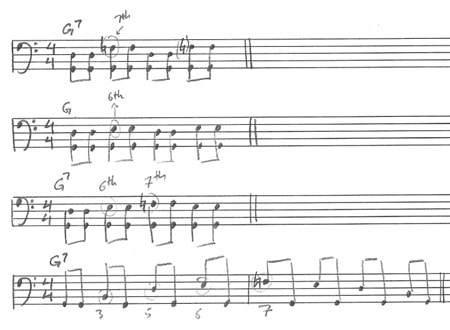
Examples include Hugh Laurie’s “Swanee River,” Oscar Petterson’s last solo on “Night Train,” and Otis Spann’s work on Howlin’ Wolf’s Moanin’ at Midnight. Don’t let their virtuosity intimate you – their left hands are surprisingly simple!
Pattern 5: Stride Piano
“Stride piano” refers to an entire genre of early jazz piano, which in turn got its ideas from ragtime. Nowadays, it’s often used in country and blues.
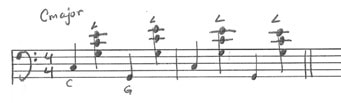
In the stride style, the left-hand plays roots and thirds on beats one and three, and plays the full chord an octave up on beats two and four.
Does the description sound confusing? I don’t blame you – the picture below makes much more sense!
While simple to understand, stride piano is tricky to master. You have to “trust” that your left hand will hit the right bass note while you play melody in your right hand, as it’s often out of your peripheral vision.
But if you can play it well, it’s a blast! For examples, check out Thelonious Monk’s recordings of “Blue Monk” (Alone in San Francisco, around 2:00) and anything by Scott Joplin.
Pattern 6: Riffs and Ostinatos
We’ll end with energetic riffs and ostinatos. Like stride piano, they’re simple to understand, but devilishly difficult to play.
Riffs and ostinatos are repeating groups of notes, usually driven forward by strong rhythms and catchy melodies. Think of the colossal grooves in metal guitar, or the percussion in Cuban music.
The repetitiveness of riffs and ostinatos create a hypnotizing foundation for dazzling melodies and rhythmic exploration. And while they might be more common in percussion and guitar, they are still used quite frequently on piano.
When playing ostinatos on piano, remember these two things: first, it’s all about the beat. Second, less is more. You’ll be surprised at how sparse piano ostinatos can be.
To gain inspiration for yourself, check out Herbie Hancock’s original recording of “Watermelon Man,” (first measure) and Rai Thistlethwayte’s cover of “Come Together.” And if you’re really feeling like a new challenge, check out Keith Jarrett’s classic encore from this concert in Japan … good luck 😛
Conclusion
While not exhaustive, I hope this article gave you several ideas for building your left-hand technique. Don’t feel like you have to try all of them at once. Simply experiment with the ones you find interesting, and see where it takes you!
Remember, it doesn’t have to be complicated at all! One simple idea can flower into a wide array of sounds.
With that said, I’ll leave you with this video, showing how “Autumn Leaves” can be played in 10 different styles. Try and figure out what the left hand is doing in each version. Do you recognize any of the techniques I mentioned?
Until next time, enjoy your musical journey, and always, ALWAYS have fun!
