
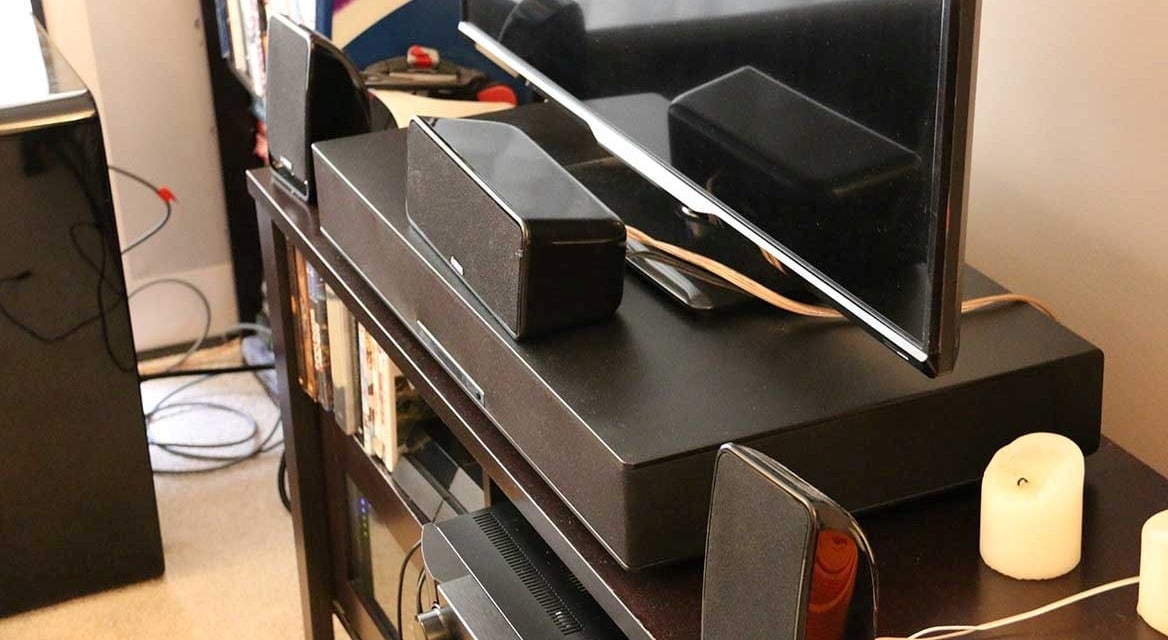
My friends had always made fun of me because I’m super meticulous with gain-stage leveling and having my monitors tuned in my music studio. However, whenever I invited people over to watch movies with my surround sound at home, they always complained.
Some said the bass was too loud, while others said it was not loud enough and they couldn’t hear the dialogue. It’s always “Hey Tomas, you’re the engineer, fix it.”
So I finally gave in to stop the bickering, grabbed my TestHifi App to do an initial test around the room, and realized just how different the levels were perceived depending on where you sat.
The next day, I set out to tune my home theater and surround sound setup the way I tuned my recording studio. In the process, I discovered some interesting differences which I will share with you.
Home Stereo Speakers
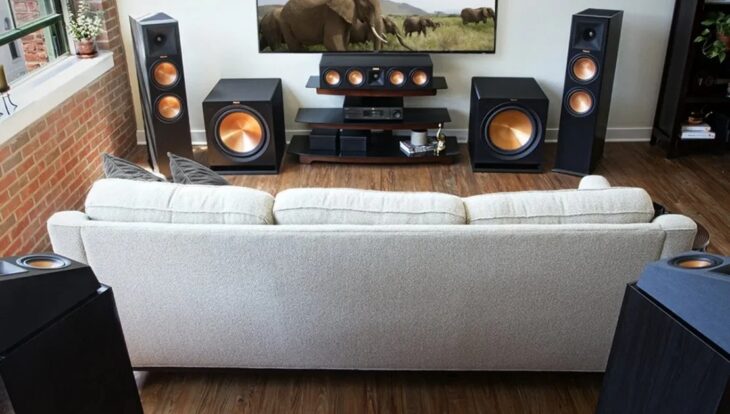
So, when I first started setting up my home studio, I learned that home audio speakers distribute sound better at lower dB settings than studio monitors. So what is the optimum loudness level?
To give you an idea, a chainsaw or a live concert is around 110 dB, while a plane taking off measures around 90 dB, as does a motorcycle, and your average conversation at a restaurant is probably around 60 dB.
I noticed that my Apple Watch always started buzzing when it was trash day or when Harley Davidsons passed by. It makes sense since the Apple Watch trigger is set to around 80 to 100 dB.
So, if you’re worried, especially with company over, about whether your home theater speakers are at a dangerously high level, particularly if you have kids, I’d say the danger point starts above 85 dB. Therefore, the best setting to calibrate your speakers is 75-80 dB. I have mine at 75 dB.
The secret to getting the most out of your speakers is maximizing headroom. To put it simply, it means hitting your speaker’s sensitivity just below where it could start distorting, usually 10 dB less than the max sensitivity specs.
It doesn’t mean you always have to be that high, but it means your receiver’s 0 is around that level. Since most home studio speakers start maxing out around 85-90 dB, it puts you in that sweet spot number.
Even though home theater speakers are known to be colored (meaning they heighten certain frequencies for dramatic purposes) to give it that extra edge and crispness that digital content and entertainment need these days, they still produce very clear sound when below 75 dB. Studio monitors tend to taper off the highs and definitely the lows as you start lowering the sound.
When you’re buying home theater speakers, definitely get speakers that have higher sensitivity, even those that may have ranges of 85 to 95 dB. The reason for this is that usually speakers like that have stronger drivers, and just having the headroom of that extra little gain will improve your sound, even when played softly.
5.1 Surround Sound
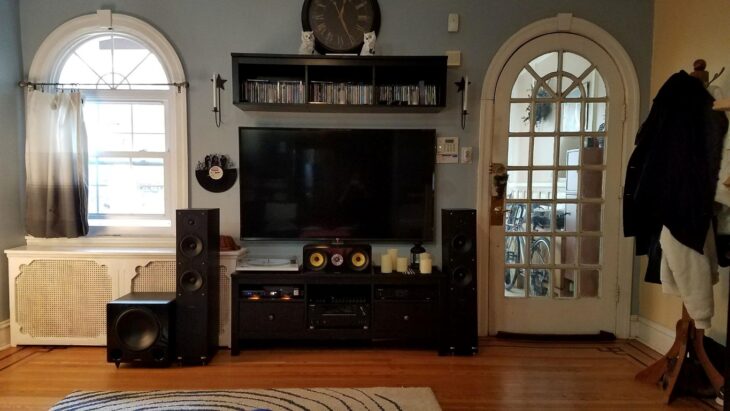
Have you ever noticed that you need to turn up your AV receiver really high to get the sound you want from your surround system? No worries, that’s actually the right way to set up your 5.1 surround mix.
It’s all about how you distribute the sound around the room, so the left and right speakers need to be maxed out or calibrated to that 75dB threshold. Then, you can turn up your AV receiver and consider it the gold level.
Keep in mind that the other speakers in the surround setting will be easier to configure once the main Left and Right are in the sweet spot.
Now, let’s talk about the size of the room and speaker positioning. If you have a big room, you might be able to squeeze another 5 dB into the system and calibrate around 80 dB.
For optimal positioning, put the left and right speakers in the front corners of the room facing you, with the subwoofer on the floor in the center, and the rest of the surround speakers slightly behind the couch or viewing area.
And don’t forget to make sure the surround speakers aren’t hitting you directly at your ear level, but slightly higher, except for the subwoofer – that one should be on the floor.
One more thing to keep in mind: parallel walls can cause reflection and imbalance, especially for sub-frequencies. That can make things sound nasal and annoying, which nobody wants.
To fix this, try getting some acoustic treatments like bass traps to put in the corners. They’ll reduce the parallel trapping of low sound and make your setup sound so much better.
7.1 Surround Sound
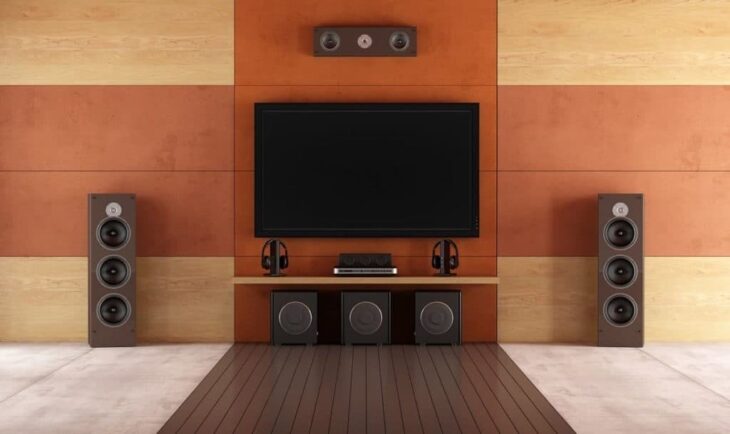
At my place, I opted for 7.1 surround sound because, as an audio engineer, I am fixated on getting as much detail and clarity as possible. In my opinion, it also offers improved sound quality, especially for gaming.
The distribution of dialogue, sound effects, music, and overall detail is much better with the two extra speakers.
With 7.1, you have a bit of extra bandwidth to distribute among the eight speakers compared to six speakers in 5.1. I found that you may need to increase the volume by 5-7 decibels to reach the sweet spot.
For 7.1, I recommend calibrating around 78 to 80 dB but keep in mind that this depends on the size of your room. In my smaller room, I kept it at 75 dB. I’m also more paranoid about hearing loss because I’m a mix engineer, so there’s that.
It’s a bit trickier with 7.1 because you need to angle the extra speakers correctly, especially the ones in the back. There’s no one right way to do it because every room is different, so it takes a little trial and error.
I suggest angling them downward instead of placing them on stands facing the viewer’s head straight on.
The reason for this is that the reflections from the ceiling corners can be more easily controlled than in the middle of the room, especially if your walls are parallel and your room is square.
Final Thoughts
So, when you’re tuning your room at home, my advice is to go wild and add as much absorbing material or decoration as possible. If your living room is pretty bare, with wooden floors and high ceilings, you’ll get a lot of early reflections.
My suggestion is to add a variety of rugs, window treatments like curtains, and maybe even some bass traps in the corners to minimize sub-reflections.
Not only does it make the vibe cozier to relax with friends and family, but it also makes the listening experience much better.
I hope that helps!

Informative and precise, well done
Excellent. Very well written. Provides a lot of basic information.
Excellent information. I have been an audiophile my entire life and I am very appreciative of what you’ve shared here. Thank you.